Tuesday, August 27, 2013

Herbal Sedatives Part 2: Kava-Kava & Valerian

High Quality Hawaii Kava
where Paul Strauss works in the winter
         
      Next we have a very popular sedative herb, Kava-Kava, whose botanical name is Piper methysticum. It is commonly known as a muscle-relaxant, and a traditional social drink among traditional Polynesian people. Having great ritual and cultural significance, it was taken as a daily tonic (Brown, 129), believing it helped them to communicate with their gods. Hawaiian native American tribes chewed the root for sharp, blinding headaches, lung troubles, chills, and to prevent contagious diseases, including: skin diseases and eye troubles, and weakness of body (Moerman, 365). Used in an alcoholic drink for incuding hallucinogenic states during religious cermonies, stimulates than depresses the nervous system (Mabey, 96).
            Piper methysticum’s properties include: analgesic, sedative, euphoriant, antiseptic, anti inflammatory (Balch, 85); Aphrodisiac, diuretic, (Brown, 129). Eases insomnia, fatigue, nervousness, giving a deep restful sleep with vivid, clear and colorful dreams, and also relaxes tense muscles, useful for chronic pain (Brown, 129), and due to it containing kavalactones releases tension in the skeletal muscles, so is a muscle relaxant overall (Balch, 85). The analgesic strength of kava is comparable to procaimadie and even cocaine, also deadens the pain of kidney and urinary tract infections, the painkilling effect is felt for up to 24 hours (Balch, 86).
Paul Strauss, owner of Equinox Botanicals
showing us how to make Kava tea
            Kava doesn’t impair user’s mental alertness, unlike other heavy duty sedatives, though the lactones present in this herb, tend to have a depressant effect on the central nervous system (Brown, 129). Overall, German researchers have found that kava is effective in treating anxiety, based on measured brain waves of people who were subject to anxiety (Keville, 33). Kava is found to improve mental functioning and mood, and contains several chemical constituents which interact with the brains benzodiazepine receprots (also activated by tranquilizers) (Balch, 85).
            In one of several clinical studies, kava helped more than 50 people reduce both depression and high anxiety levels, and this difference was noticed only after a week. Another study, conducted in Germany where kava was given to women who suffered from “anxiety, depression and other symptoms associated with menopause, the symptoms were relieved and women reported and increased sense of well being” (Keville, 32). Lastly, several other studies showing that people with symptoms of moderate to severe anxiety, including “agoraphobia, social phobia, and anxiety disorders, were “significantly reduced in people who took kava versus placebo” (Balch, 85).
            Next we have another favorite gentle-sedative herb of mine, Valerian. Having gotten a bad rap/reputation from being an addictive substance by Hitler, it’s fame can be traced back to the 1300s when it was recommended to cause “truculence, [or] having a truce [from fighting]”. If you gave valerian to two combatants, thought… the writer urged, that they would immediately become tranquil and lay down their weapons (Foster, 193). This interesting smelling root herb was also utilized in 1592 by Fabius Cauna who is said to have cured himself of epilepsy, it was also used for treating shell shocked soldiers throughout WWII (Seymour, 118-120).     
us hand-making kava tea
was very strong but so relaxing
            Valerian, coming from the Latin valere, means “fare well” and was often referred to as all heal in English, (Seymour, 118), not to be confused with the commonly called all heal which is Prunella vulgaris; Valere, was also thought to mean “to be powerful or of well being” (Brown, 144). The Greek philosopher Discorides, referred to this plant, in the 1st Century, as “phu” which accidentally got turned into “phew” and this is where we get the common phrase “pee-you”, meaning something smells …in a bad way…similarly to how valerian root actually smells, like insanely dirty gross socks (Foster, 193).

            Historically, was commonly used for a slew of ailments, including: migraine, hysteria, vertigo, insomnia, and convulsions.  Culinary-wise, the poorer classes of Northern England found it “essential in flavoring soups and broths” stated John Gerard in his 1596 Herball (Foster, 193). Throughout the 17th and 18th centuries it was referred to as one of the best ‘tranquilizers’and antispasmodic herbs, and as a sleep aid. William Cullen stated /wrote in 1808 ... “its antispasmodic powers in genera are very wel established: and I trust to many of the reports that have been given of its efficact”(Foster, 193). Later, was officially listed in the United States Pharmacopeia from 1820-1936 (Foster, 194).
            Presently, valerian is commonly sold in tincture and teas, whose properties include: antispasmodics, anodynes, carminiatives, hypnotics, nerviness; worm expelling. This sedative herb also relieves stress, muscle spasms, cramps, mental depression, despondency, migraines, insomnia, fatigue and nervous conditions. Valerian root affects the central nervous system, stimulating it in fatigue and calming it in agitation (Foster, 193), thus helping to relieve anxiety, encourage sleep and improves quality of sleep (Brown, 144). Relaxes muscles to the digestive tract, soothes that system, and relieves indigestion, constipation, especially when due to nervous tension; valernic acid is believed to be one of the antispasmodic compounds, treating IBS, and cramps (Balch, 139). Valerian root has similar compounds as barberry, goldenseal, Oregon Grape Root (berberine), and Echinacea, thus inhibits candida (Keville, 81), and has been used in dozens of over the counter sleep aid medications (Balch, 139).
part of our group at United Plant Savers'
'Goldenseal Sanctuary' waiting turns to make kava tea
            Experimental data indicates that there is a scientific basis for valerian being a mild sedative, having antispasmodic properties and relieving pain and increasing coronary blood flow (Foster, 194). Related to the latter bit, it might help slow brain damage due to excessive alcohol consumption (Keville, 28). Large studies have confirmed, that as a calmative herb, it helps improves: restlessness, nervousness, insomnia, hysteria, headaches, nervous stomach, menstrual problems, circulation and lower blood pressure (Balch, 138). Overall, one study’s findings were interesting, valerian seems to be what you need it to be, it is “sedative for agitated patients, while it stimulates someone who is suffering from fatigue” (Mabey, 124). Related to this idea, a Germany study amazingly enough, (U.S. take note), successfully treated children that were hyperactive, and found valerian to greatly “improved their learning skills, muscle coordination, and reaction time after taking for [only] a few weeks”, they were also less anxious, aggressive restless and fearful over 25% of the children completely recovered! (Keville, 229-230).
Valerian at Quiet Creek Herbal farm
Brookville, Pennsylvania
            Studies done in Germany, in 1993, concluded that valerian helps you to fall asleep more quickly, especially if you are elderly or habitually are a poor sleeper, and in addition, it helps you to have improved deeper stages of sleep, thought to be due to a similar compound found in the sedative barbiturate, by depressing the nervous system (Keville, 38). Lastly, another similar study (double-blind), done of 128 participants, showed that by taking a water-based extract of valerian this improved subjective ratings of sleep quality, reduced the time in which it took to fall asleep (sleep latency), also relieved insomnia, leaving the participants without the side effects of grogginess or the ‘hangover’ feeling (Balch, 139).

Works Cited Part 2~
Balch, Phyllis A. Prescription for Herbal Healing: A Practical A-Z Reference to Using Herbs with Vitamins, Minerals, Nutritional Supplements, Natural Healing Techniques, and Prescription Medications. New York: Avery, 2002. 85-85, & 138-139. Print.
Brown, Kathleen L., and Jeanine Pollak. Herbal Teas: 101 Nourishing Blends for Daily Health and Vitality. Pownal, VT: Storey, 1999. 129 & 144. Print.
Foster, Steven, and Steven Foster. Herbal Renaissance: Growing, Using & Understanding Herbs in the Modern World. Salt Lake City: Gibbs-Smith, 1993. 193-194. Print.
Keville, Kathi, and Peter Korn. Herbs for Health and Healing. Emmaus, Penn.: Rodale, 1996. 28, 32-33, 38, 81 & 229-230. Print.
Mabey, Richard, and Michael McIntyre. The New Age Herbalist: How to Use Herbs for Healing, Nutrition, Body Care, and Relaxation. New York: Collier, 1988. 96 & 124. Print.
Moerman, Daniel E., and Daniel E. Moerman. Native American Medicinal Plants: An Ethnobotanical Dictionary. Portland, Or.: Timber, 2009. 365. Print.
Seymour, Miranda. A Brief History of Thyme and Other Herbs. London: John Murray, 2002. 118-120. Print.


Wednesday, July 31, 2013

Gentle Herbal Sedatives: Lemon Balm, Lavender & Beyond

            A favorite herb of mine, year round though even more so in the summer, is lemon balm. Melissa officinalis, being its botanical name, and Melissa, or balm, for short throughout Europe, has been a major staple of summer drinks in modern times, and was noted that it “makes the heart merry” by the middle eastern herbalist Avincenna (Mabey, 68). Melissa was historically referred to as “elixir of life” and “heart’s delight” due to the legend saying it would bring one joy (Brown, 130). Being reported to renew youth, strengthen the brain, and “relieve languishing nature and prevent baldness” (Seymour, 72) stated in the 1691 London Dispensary. Apparently so, Maude Grieve mentioned in one of her books that two venerable gentleman, owed their ripe old age, of 108 and 116, to drinking lemon balm tea every morning. Also in the Victorian language of flowers this herb represented “social conversation, and [restoration of] youth” (Brown, 130).
Melissa officinalis
my yard
 Minneapolis, MN
            Lemon balm is a tender perennial, being upright in nature, and is originally native to Southern Europe, though has been naturalized throughout England, France, and a majority of the United States. Grows to about 2 feet in height, has hairy square stems (mint family), with 2-3 inch oval/heart shaped leaves, and scalloped edges. Prefers and thrives in cool, shady habitats, loves moist fertile soil (Foster, 116-117). Amazingly enough, this is one of those rare herbs that the Ancient Greeks really had nothing to say about it, which is ironic in my mind, due to their “fondness for honey, and the fact that Melissa is the Greek for honey bee” and bees love lemon balm when in flower, gardeners do not because than it is spent (Seymour, 71). On that note, John Gerard mentioned in his Herbal that bees are “delighted with this herbe above all others” and appropriately, medieval gardeners grew it near where bee hives were kept, and smeared it in the inside of the hives to bring in a lost swarm (Seymour, 71).
            Culpeper recommended that a syrup made from “the juice of lemon balm mixed with sugar be kept in every gentlewoman’s house to relieve the weak stomachs and sick bodies of their poor and sickly neighbors”. Melissa was highly-valued by Paracelsus, who sold it for a very high price to royals, for its relaxation purposes. Externally, Gerard in the 16th century noted this herb “glueth together greene wounds” which is now supported by evidence that it contains hydrocarbons in balsamic oils, which starves germs of oxygen, thus killing them (Mabey, 19). In his day it was one of the most popular lemon herbs, due to its hardiness. Edwardians liked it planted in broad bands in front of sweet cicely and angelic for attractive contract in height (Seymour, 71). It was also used to treat fevers, uterine disorders, gripping bowels, impotency, senility and a disordered mind”  Relaxes nerves, thus improving tension headaches and migraines, even more so when mixed with skullcap and lavender; safe for pregnant women to treat allergies and hay fever, calm nerves, treat depression, insomnia, headaches and digestion ailments related to pregnancy (Levy, 20). Lastly, historically Native Americans, specifically the Cherokee, used Melissa officinalis for treating “ ‘old colds’, typhus fever, chills and overall fevers… for colic and stomachaches”, and as a tonic and general stimulant (Moerman, 303).
            Balm in the modern-world has the same properties as historically, including:     being a safe and gentle nervine, anti-inflammatory, astringent (due to tannin content) (Brown, 130), Carminative, diaphoretic, febrifuge, essential oil is sedative and relieves spasms; sedative, antiviral, antibacterial (Balch, 90); treats: colds, flu, nervous headaches; aromatherapy: for nervousness, depression, insomnia and headaches as well (Maybe, 68). Hot tea promotes sweating in colds accompanied by fevers (Foster, 117). Overall is an excellent herb for treating many nervous disorders, including overall stress, an overly taxed nervous system and digestive system, thus being good for: IBS, diarrhea, constipation, eases indigestion, flatulence, stomach cramp, menstrual cramps; also antiviral in action, so good for herpes (cold sores), soothes/prevents insect stings, prevents insomnia (Balch, 90).
Melissa officinalis my backyard
Minneapolis, MN
            Two experiments indicate that lemon balm eases insomnia through two complementary mechanisms first exposed to environments displaying behaviors of stress, exhibited few of these when get sleeping pill, needed less of a dose with lemon balm. It also seems that when combined with valerian, hastens sleep, relaxes muscle tension especially in people with ADD, without causing any daytime drowsiness. Lemon balm also possesses flavanoides and polyphenilcs, which have been identified as inducing thyroid-regulating actions; block attachment to thyroid cells by the antibodies that cause Grave’s disease, thyroid stimulating hormone (TSH), also blocked from further simulating the excessively active thyroid gland (Balch, 90).
           Lemon balm cream is sold in Germany for cold sores and herpes simplex, which studies show reduced healing time in herpes lesions and lengthens time between recurrences (Foster, 117); in another study, double-blind of 116 people, who got lemon balm or placebo, the group that received the lemon balm had significantly; greatly improved symptoms of daily …50% peoples symptoms free than in placebo group also had less skin damage , prevented spread of infection and relieving itching, burning, tingling, swelling  (Balch, 90). My favorite ways to enjoy lemon-herbs is in the form of: herb-infused waters, teas, lemonades, and hibiscus lemon verbena tea ice cubes melting in cold white wine. My favorite way to take lemon balm is in tea, specifically in my Sleepy Tea, which is at my Etsy store https://www.etsy.com/listing/115742694/organic-herbal-sleepy-tea?ref=shop_home_active , otherwise if I too tired after work to make tea, I take tincture made with my own home-grown lemon balm.
NOTE: do not take lemon balm TINCTURE if you are taking barbiturates, the creams do not interact with the drugs (Balch, 91)

Lavandula spp. Quiet Creek Herb Farm
Brookville, PA 
Lavender coming from the Latin Lavare, meaning “to wash”, and represented “tranquility and purity” (Brown, 129). The Ancient Greeks and Romans used lavender in their baths as an antiseptic and antibacterial (Brown, 129). It was historically used, also: for asthma, weakness, swelling, vomiting, headache, parlysis, sunstroke, and was used as a mouth wash for bath breath and loose teeth (Levy, 94). In Georgian and Victorian England was used for: hysteria, dizziness, fainting, “lowness …and other nervous affections” (Seymour, 69); thus cited as “get the smelling salts!”
            Currently lavender is primarily used in cosmetics, perfumes and in the field of aromatherapy, to gently relieve fatigue (Keville, 289). Its properties are: antiseptic, mild sedative, muscle relaxant (cramps and asthma), painkiller (headaches, rheumatism), sunburn/burns (Bremness, 112) & (Huson, 60) and treats: depression, yeast/fungal infections, laryngitis, sinus/lung congestion (Keville, 232). Lavender has also been shown to ease pain, swelling, helps repair damaged cells, by making broken “capillaries stronger”(Keville, 319),deter[s] infection…prevent[ing] burns from scarring” (Keville, 255).
            Italian researchers have found that this herb stimulates immunity (Keville, 105), and German study shows essential oil “possesses antifungal properties” (Keville, 81). Studies show that Lavender, along with “lemon… thyme, chamomile…(in that order) increase the number of white cells, which gobble up infection-causing bacteria” (Keville, 257).

Chamomile  “It has floures wonderfully shynynge yellow and resemblynge the appell of an eye” –William Turner (Seymour, 15). Roman or English Chamomile, Anthemis nobilis, German Chamomile, is Martricaria recutita. The common name of this herb, comes from the Greek kamai, meaning “on the ground”, and melon, meaning “ground apple” (Brown, 116). Other names of this herb have included: corn feverfew, barnyard daisy, turkey week and earth apple. Having historically been a “doctor for plants” by “promot[ing] healthy growth of all nearby” (Brown, 116). Ancient Greeks and Egyptians “dedicated chamomile to the sun” (Seymour, 15). It was commonly valued by the Arabs, as one of the “best remedies for infants’ ailments” along with insomnia, depression, whose poultice externally is for pain (Levy, 37). Victorian cottage owners believed that a “chamomile bed, the more it is trodden, the more it will spread” (Seymour, 16), why they walked on it daily. Was attributed as an anti-aging herb in Middle Ages, due to its “disinfectant properties” (Brown, 116).
historic print of Chamomile
            A major property of chamomile is anodyne. It is currently used to treat: colds, and flus, burns and sunburns, sprains and strains. Chamomile oil inhibits inflammation, treating: ulcers, wounds, eczema (Bremness, 256), and increases white cell count which “gobble[es] up infection-causing bacteria” (Keville, 257). Chamomile repairs skin “lavender, rose…make weak and broken capillaries…more resilient, [and] soothe[s]…skin and reduce[s] puffiness” (Keville, 319).


Works Cited
Balch, Phyllis A. Prescription for Herbal Healing: A Practical A-Z Reference to Using Herbs with Vitamins, Minerals, Nutritional Supplements, Natural Healing Techniques, and Prescription Medications. New York: Avery, 2002. 90-91. Print.
Baïracli-Levy, Juliette De. Common Herbs for Natural Health. Woodstock, NY: Ash Tree Pub., 1997. 20+. Print.
Bremness, Lesley. "Smithsonian Handbooks: Herbs." Barnes & Noble. N.p., n.d. Web. 31 July 2013.
Brown, Kathleen L., and Jeanine Pollak. Herbal Teas: 101 Nourishing Blends for Daily Health and Vitality. Pownal, VT: Storey, 1999. 130. Print.
Coon, Nelson. Using Plants for Healing: An American Herbal. 2nd ed. N.p.: Rodale, 1979. Print.
Foster, Steven, and Steven Foster. Herbal Renaissance: Growing, Using & Understanding Herbs in the Modern World. Salt Lake City: Gibbs-Smith, 1993. 116-17. Print.
Huson, Paul. Mastering Herbalism: A Practical Guide. Lanham, MD: Madison, 2001. 60. Print.
Keville, Kathi, and Peter Korn. Herbs for Health and Healing. Emmaus, Penn.: Rodale, 1996. 81-319. Print.
Mabey, Richard, and Michael McIntyre. The New Age Herbalist: How to Use Herbs for Healing, Nutrition, Body Care, and Relaxation. New York: Collier, 1988. 19+. Print.
Moerman, Daniel E., and Daniel E. Moerman. Native American Medicinal Plants: An Ethnobotanical Dictionary. Portland, Or.: Timber, 2009. 303. Print.
Seymour, Miranda. A Brief History of Thyme and Other Herbs. London: John Murray, 2002. 15+. Print.


Wednesday, July 3, 2013

Allergy Blog Part 2: Allergy Herbs and DIY herbal Recipes

                     One of my favorite allergy and anti-histamine herbs is Thyme, which “According to legend, thyme sprouted from the tears of Helen of Troy” (1). Many writers, myself included, have always seemed to have a ‘soft spot’ for thyme, possibly due to its lack of nick-names “a spring of thyme is a spring of thyme, sweet and plain” (2) Coming from the Greek thymon, (1), or “Thumon, was …[a] symbol of thumos, [being] spirit [or]…courage” (3)and was appropriately believed to help overcome shyness. Like many other herbs, thyme was used in the realm of magic, for showing one’s true identity. In Edmund Spenser’s Faerie Queen, Duessa’s ‘true colors’ were shown, from bathing in a magical brew of thyme, oregano and rue— where instead of being young and beautiful, she turned out to be a “filthy foul old woman” (2).
Coltsfoot leaves
Rutland, Ohio

            Ancient Greeks and Romans, considered thyme a “strong antiseptic [and disinfectant] and [was] credited with a multitude of powers, including anti-aging”, and was used by the ancient Egyptians as an embalming herb (1). Thyme was lastly used to help one glimpse faeries, and medicinally for treating: flatulence, inflamed liver, bad breath, sore throats, headaches and fevers (4). In Nicholas Culpeper’s day it was a popular herb as a “digestive, and for hangovers…whooping cough, and as a purge for catarrh and for any lung-connected illness” (3). Currently, thyme is still thought of as an antiseptic, calming and nerve tonic, treating muscular pain, depression, colds (5) also for lung and sinus ailments (congestion), expectorant (6). Related to the immune-system, and Italian researchers “found...thyme… stimulate[s] immunity” (7), and it also “stimulates production of white blood corpuscles to resist and fight infections [and] promotes perspiration” (1).
            Next we have sage, being an herb and a type of person. It was once said that a “tea of sage tops is one of the most refreshing and beneficial available to mankind”~ Juliette de Bairacli-Levy (8). Sage’s name, comes from the Latin salare meaning “to cure”, or salvia, meaning “to save”. Being a major herb in Native American culture, sage was called “mashkodewashk aniibiishan” by the Ojibwe, and overall was used as for cleansing and purifying. Specifically sage cleaned the eyes, removed body odors and poison ivy. The leaves of sage were burned in a lodge during contagious illness to purify the area. The syrup or honey of the plant was used to treat asthma, and the leaves were specifically smudged, eaten and smoked, treated coughs and colds. Was also used for: fevers, congestion, sore throats, digestion (lack of appetite, flatulence, constipation). Externally: wounds, sores, excessive bleeding (8). Lastly, historically, William Turner in his 1568 Herbal said clary sage “helps the memory [and] quickens the senses” (9).
            Currently sage’s properties include: disinfectant, antiseptic, aromatic and astringent. Overall this herb calms and strengthens the nerves, thus “relieving nervous headaches, help[ing] ease lung congestion [colds and flus]…stimulates digestion/liver function” (10). Sage also contains a specific hydrocarbon, known as salvene, which is astringent, aromatic, and is stimulating and bitter, and seems to enhance memory.
Mullein
Brookvilla, PA Quiet Creek
Herbal Farm


            Next we have the herb Coltsfoot, or Tussilago farfara, of 
the Compositae family. This herb is normally found on sunny banks and in waste-places. Coming from the Latin Tussis, meaning “a cough”, and ago meaning “to banish”, obviously refers to its power of ridding one of coughs. Other names of this respiratory herb include: horse-hoof, bull’s-foot, ass’s-foot, son before the father (referring to the fact that the leaves come before the flowers), cleats, coughword, tushylucky (scots name) (12) the broad sea green leaves bear a striking resemblance in shape to small hooves. This is one of the earliest flowers you’ll see in spring, oddly appearing before the leaves, which are almost round, being grey-green in color, and paler on the underside, with a thick down web on the top. The leaves retain a fragrant scent after drying, and the flowers are a bright yellow, with scaly stems. Interestingly, coltsfoot was one main herb the British settlers took with them to the new world (12).  Coltsfoot is a “supreme pectoral herb” curing: coughs, pneumonia, pleurisy, bronchitis, asthma, tuberculosis, and provides major relief for those suffering from whooping cough. Pliny recommended inhaling the smoke of coltsfoot’s leaves over a fire of cypress wood (12). Excellent at expelling mucus from throat and lungs, coltsfoot is also a useful fever herb, of which peasants used to say that it comes in time for the spring fevers. Pounded the leaves are excellent as a poultice for inflammation and swellings of many kinds. The leave can also be applied to the lung area, and the hot infusion was applied with a cotton cloth for respiratory ailments; snuff up the nostrils to remove obstructions and relive sinus infections, Gypsies would smoke as a “tobacco” (11).
            This herb had such a renounced reputation that in the pre-Revolutionary times in Paris its “flowers were painted as a trade sign on apothecaries shop signs”. Later in time, John Gerard noted that this herb seems to “growth of itself neere unto Springs, and on the brinks of brookes and rivers…in wet furrows, by ditches sides, and in other moist and watery places neere unto the sea, almost everywhere”. The leaves when pounded and mixed with honey were believed to be a sure cure for inflammation, and in the 18th century the botanist Linnaeus, noted that it was smoked in Sweden and England for respiratory ailments (12). Now a days, coltsfoot is one of those odd weed-type herbs that people have heard of, but may have never seen let alone used, like myself till I had the pleasure of meeting it in person several years ago. I enjoy coltsfoot along with other anti-histamine and allergy/bronchial herbs, such as thyme, yarrow, sage and goldenrod for whatever respiratory-ailments come my way.
Elecampane
http://botanical.com/botanical/
mgmh/e/elecam07-l.jpg
            Mullein is another interesting waste land herb. Its botanical name is Verbascum Thapsus, and is the Scrophuariaceae family, is a strikingy-tall herb, with broad downy leaves, and flowers in tall yellow spikes. The leaves are nick-named “blanket herb”, and was commonly referred to as “cow lungwort” by the Native Americans, since it was a standby remedy for lung ailments, in cattle and people. Mullein’s leaves and flowers are generally used, dry well, especially because the leaves are easily susceptible to mold, and the flowers to blackening if exposed to light. More of its popular folk names include: candle light, having been used as wicks (13),  having been dipped in tallow to be candles and torches (14) Adam’s flannel, shepherd’s staff, velvet plant, cuddy’s lungs, beggar’s blanket, ray paper, candle-wick plant, hag’s taper, hare’s bear, duffle and clot (14).  It was believed that Ulysses used mullein to “guard against Circe’s wiles” and John Gerard noted that if it was collected when the “sun was in Virgo and the Moon in Aries [it] offered protection against the falling sickness”. Women in the Renaissance period would rub the flowers of mullein into their wet hair to “encourage fashionable blondness” (14). Along with treating cow lung ailments’, mullein was traditionally used to treat anything relate to the chest area, including: coughs, pneumonia, pleurisy, bronchitis, tuberculosis, asthma (inhalant and tea), bleeding from nose, lungs, bowels mouth, dropsy, hay fever, insomnia, headaches (13); as well as: toothache, earache, piles and haemorrhoids (14). For dysentery, and bleeding from the bowels, mix 1 tsp mullein leaves, with 1 cp new milk, add honey, cinnamon, nutmeg, and take 2 Tbsp after each bowel movement, or at least 3 x/dy (13).
            Externally: a hot tea was made and you use a cloth soaked in it to heal mumps, swollen glands, inflamed tonsils, stiff neck, warts and sore throat. Similarly make a tea of it and use as a steam, inhale for: hay fever, all lung and sinus congestion (13). Interestingly, the seeds were used by fisherman, to stupefy fish, being narcotic in property, and until the early 20th century Irish gardeners used as a cure for ‘consumption’ said John Gerard, lastly, shepherds and wanderers would put the leaves in shoes as thermal protection (14).
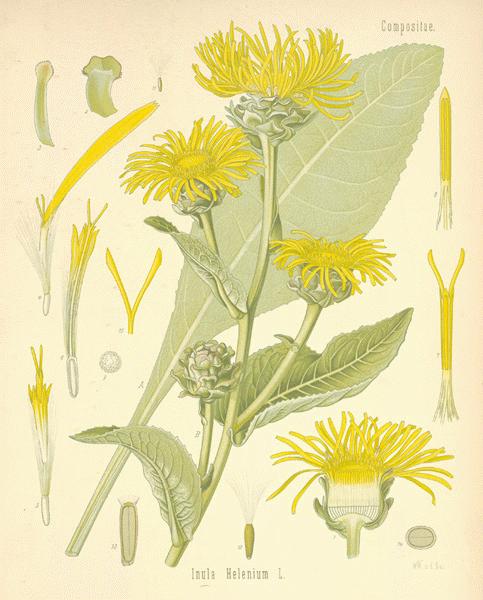
            Another popular folk-herb for respiratory ailments, though being not as common, is Elecampane, or botanically referred to as Inula viscose, or Inula helenium. Being from the Compositae family, it can be often found in slopes and hillsides. Elecampane possesses bright green, sticky leaves, which are pungent thanks to the glandular hairs which protect it from becoming afternoon snacks of a grazing flock. This herb has bright yellow flowers, and was historically used for treating lung ailments, including: pneumonia, bronchitis, asthma, hay fever; coughs, whooping cough (15). More commonly this interestingly looking herb was used externally, especially favored by the Arabs to treat stiffness (infusion as a bath) and rheumatic complaints. As a vapor it was commonly used to strengthen the lungs, and promote mucous draining from the throat and lungs. Lastly, elecampane was used by Spanish peasants, notes Juliette de Bairacli-Levy in her book “Common Herbs for Natural Health”, by hanging the branches on the ceilings of their homes, insects/flies would gather on them and they would thrust the plants with stuck bugs into sacks in the night, and plunge into water, to thus drown them (15).
Chocolate Mint
            Lastly, an interesting lung herb is Horehound, specifically white horehound, Marrubiu vulgare, being in the Labiatae family. Horehound, comes from the Old English hoar, meaning white, due to its downy-white leaves (16). This herb is also found in waste places, preferring poor soil, and possess grey-green leaves, being slightly wollen. Has small pungent flowers, in whorls, best gathered when young, and overall the plant is in the best quality when collected before flowering (17). Internally horehound is excellent also for lung ailments, specifically coughs, colds, hoarsness, asthma, tuberculosis, sore throats, and to reduce fevers. Contains the compound marrubium, which is thought to promote perspiration and the flow of urine in a person, also vermifuge and laxative in action  (17). Currently approved in Germany for treating bronchial congestion, and hundreds of bronchial medication across the world. Interestingly, this herb seems to influence the brain that controls respiration, causing perspiration, cooling a person due to heat and fevers (16).

Bronchial and Respiratory Herb Recipes:
        Hay Fever tincture: 1 tsp each: Siberian ginseng, nettle, elder flowers, peppermint
        Lung Tincture: 2 tsp mullein leaf tincture, 1 tsp each: chamomile, elecampane; ½ tsp each: thyme, Oregon grape root (or barberry, or goldenseal).
       Vapor Rub: ¼ tsp eucalyptus essential oil, 18th tsp peppermint and thyme essential oils (each), ¼ olive oil. Combine in a bottle, shake well, massage on chest and throat.
*above recipes courtesy of Kathi Keville’s book Herbs for Health and Healing*
        Horehound syrup: heat together 1 cp brown sugar, 2 Tbsp honey, juice of half of a lemon (1 tsp), 1 tsp sunflower oil, when has thickened (over medium heat??), stir in a strong standard brew of horehound leaves (that have steeped overnight) (17). 
         Decongest and Feel your Best Tea:
2 parts yerba santa leaves                 2 parts sage eaves
1 part ginger root, freshly grated      1 part nettle leaves
1 part peppermint leaves                   1/8th part licorice root                  
*combine all herbs in pot and cover with boiling water, steep for 15-20 minutes*
        Get Rid of the Drip Tea:
2 parts elderflower              1 part ephedra leaves *outlawed by FDA*
1 part goldenrod leaves        1 part nettle leaves
*combine and cover in a tea pot with boiling water, steep 15-20 minutes*
 *Recipes from Kathleen Brown’s book “Herbal Teas”

Resources:
-Thymes Ancient Remedies
-Dr. Earl Mindell’s Allergy Bible, By: Dr. Earl Mindell
-An Epidemic of Absence, by: Moises Velasquez-Manoff

Wednesday, June 26, 2013

White Willow: Nature's Original Painkiller

“The word drug itself comes from the Dutch word “drug” (via the French word Drogue), 
which means dried plant” -(Absolute Astronomy, Herbalism).

            There are many herbs which make what our medical field what it is today, as “Many of the pharmaceutical currently available to physicians have a long history of use as herbal remedies, including opium, aspirin, digitalis and quinine” (Wikipedia, Herbalism). Though in this blog I will be covering White Willow, which from my research, is what I know to be the natural origins of aspirin. Aspirin either comes from spirea, being an ancient “name for the natural pain reliever meadowsweet” (Keville, 44), or it could be from “taking the “a” from the “acetyl” and “spirin” from “Spirea””, being named after the primary compound in white willow, acetylsalicylic acid (Sumner, 135). With American’s alone consuming over 80 million aspirin tablets a year, its amazing to find how few people know of its true origins.
me with what I believe is a Salix spp. specifically
a weeping willow, in Virginia
            Salix alba, or white willow, around 2,000 years ago the Greek physician Dioscorides recommended Salix spp. “willow leaves mashed with a littler pepper and drunk with wine” to treat lower back pain. Overall was used by the Greeks to treat pain and gout, and by native Americans for headaches (Sumner, 133-134). The bark is very bitter and astringent, also traditionally being used for: diarrhea, fever, pains, arthritis, rheumatism; the poultice was used for: corns, cuts, cancers, ulcers, poison ivy and rashes (Foster & 321-322).  In Europe, during the middle ages, infusions of willow were used as a folk remedy to treat fever and aches. In 1763, a sir Reverend Edmund Stone wrote to the president of the Royal Society, that there is a “bark of an English tree, which I have found by experience to be a powerful astringent, and very efficacious in curing aguish and intermitting disorders”. Stone creatively extirpated from the traditional Doctrines of Signatures; since feverish illnesses were common in the cod, moist English countryside, that plants grow in areas to provide cures. He contended that “many natural maladies carry their cures along with them, or their remedies lie not far from their causes”, stinging nettle’s juice, usually near yellowdock, burdock (Sumner, 133-134).  
            Native Americans used many types of willow, Salix alba, being the commonly known one. The Cherokee used it as a hair wash, to stimulate hair growth, and the bark as a poultice. The root was chewed for lost voice and hoarseness, and as an overall tonic. Coastal Plain willow, or Salix caroliniana, was used for thin blood; an infusion was an emetic for ‘rainbow sickness’, as well as: fever, stiff neck, backachache, dizziness, diarrhea, headaches; for menstrual problems, and for body soreness (as a bath) and stomache. Also used for: cleaning the insides, after a death of a patient, ‘ceremonial emetic’; bark infusion for hot feet, Lion sickness: tongue hanging out, panting (Moerman, 430-435).
http://upload.wikimedia.org/wikipedia/commons/
a/a1/Thom%C3%A9_Salix_alba_clean.jpg
            Willow active compound salacin, which converts in the stomach to salicylic acid (Keville, 44), was synthesized into what is know today as aspirin, being present in this herb and meadowsweet (Keville, 5). Bark extract of Salix alba was tested between “1821 and 1829 during which time salicin was identified”, in 1838 the compound of “salicylic acid was produced through the oxidation and hydrolysis of salicin” (Mowrey, 224). White willow though, was synthesized into what is now known as aspirin in 1875, being researched primarily by Felix Hoffman, an employee at the, “Bayer division of I.G. Farben, a Germany company” (Sumner, 134). Felix originally started doing so in hopes of treating his father’s bad rheumatoid arthritis, and after giving his father the “salicylate compound” which caused his dad too much “acute stomach pain” (Sumner, 134), so by 1893, and, “produced acetylsalicylic acid from salicylic acid” (Mowrey, 224)

            The analgesic effects of willow are slower, yet longer lasting than aspirin, and do not cause internal bleeding, especially of the stomach lining (Balch, 142). It has been noted in several of my herbal books, that with aspirin being such a “a powerful, concentrated synthetic extract of, “its herbal counterparts…that medical researchers say that if it were introduced today, instead of in the more lenient nineteenth century, the Food and Drug Administration…would demand that it be sold by prescription only” (Keville, 45).
Has many of the same uses currently, as historically: fevers, colds, infections, acute and chronic rheumatic disorders, headaches, inflammation related pain
            A study found that if you combined 100 mg of white willow it reduced pain and improved functioning in people with osteoarthritis (Balch, 142).  Ten studies have found that patients with radiation treatment found that Salix SST, a saliva-stimulating lozenges containing the active principles of willow bark, relieved symptoms of dry mouth and improved sleep and speech (Balch, 142). clinical testing on willow bark in England shows, from centre for complementary heath studies at the University of Exeter, 82 participants with chronic arthritis pain herbal drug containing willow bark, or placebo…after 2 months, those on the willow bark medication found to be superior (Balch, 142).

            Personally, I love taking white willow, Salix alba, tincture for headaches, cramps, general aches and fevers, and for me it works wonders!

 Works Cited:
Balch, Phyllis A. Prescription for Herbal Heaing: an easy-to-use!-to-Z reference to hundreds of common disorders and their herbal remedies. Avery: a member of Penguin Putnam Inc, New York. 2002. Print.
Foster, Steven. Herbal Renaissance: growing, using & understanding herbs in the modern world. Gibbs Smith Publisher, Salt Lake City, Utah.1993. 87. Print. 
Keville, Kathi, and Peter Korn. Herbs for Health and Healing. Emmaus, Penn.: Rodale, 1996. Print.
Moerman, Daniel E. Native American Medicinal Plant: an Ethnobotanical Dictionary-the medicinal uses of more than 3000 plants by 218 Native American tribes. Timber Press Inc, Portland, Oregon & London. 2009. Print.
Mowrey, Daniel. The Scientific Validation of Herbal Medicine. McGraw Hill Publishing, 1st Edition. 1986. Print.  
Sumner, Judith. The Natural History of Medicinal Plants. Timber Press Inc. publishing, Portland, Oregon. 2000. Print.

Tuesday, June 18, 2013

Allergies Blog Part 1: Spring Fever & Intro to Allergies

  The idea behind spring fever historically, comes from a physical ailment, to what we now describe as mentally going a ‘up the wall’, from so much snow, cold, and just wanting some nice warm spring weather. Historically, this was a saying for what used to physically happen to people after eating lots of preserved, heavily salted meats, among other goods, for the winter. After being dormant for so long on this diet, a person’s blood was thought to be thick due to the high intake of meat, and lack of fresh greens.  Thus when someone ate their first spring greens, they came down with ‘spring fever’, a feverish state of shock, due to their body and liver not being able to process the food.

Burdock Leaves
            So now that you understand what spring fever is, lets go over some excellent cleansing herbs to help your body cope with this type of diet change. Though being from and still living in Minnesota, I most definitely eat differently in the winter. Some of the most excellent ‘spring-fever’ herbs, tend to cleanse the blood, liver, gallbladder, and kidneys. A few of my favorites, include: Sassafras, Dandelion, Stinging Nettle, Burdock, and Red Clover. Starting with Sassafras, Sassafras albidum, coming from the Laurel family, was found to be a historically useful, and commonly used spring-fever herbs. When European colonists found themselves in short supply of food, and medicine when they arrived to North America, they realized that “any berry, leaf or root could either save or kill them” (Stewart, 192). Sassafras was one of these plants, being a highly aromatic tree native to the East Coast. Its leaves and root bark noted in 1773 were medicinally utilized, in the colonies: “to promote perspiration, to attenuate thick and viscous humors, to remove obstructions, to cure the gout and the palsy.” (Stewart, 192).  Sassafras used to also be very prevelant in the Appalachian area, though I did not find this when I interned with United Plant Savers at ‘Goldenseal Sanctuary, in Rutland, Ohio, in the Southeast Appalachians. My group found some in the wild, and we were inadvertently lucky to come upon a HUGE uprooted sassafras tree, and collected root bark to make tea out of. Though, Sassafras’ root and root bark, traditionally was used to make and flavor Root Beer; best harvested in the fall when the plant’s energy is in the ground. Sassafras has three different-shaped leaves…mitten, closed hand, and pinkie-and-thumb out (rocker leaf). The leaves are mucilaginous (quenches thirst), bark looks like small hooves and are orange and green in color. The leaves are demulcent, so it’s good for someone whose mouth is dry from talking. Take this plant internally to cool blood, and externally is a warming herb—ironic.  English colonies in Virginia exported about 40 tons a year to England, which than replaced black tea for a while. Known to be a blood thinner, and good for the kidneys and heart, Sassafras is also a heroic herb like Bloodroot and Goldenseal. Sassafras leaves are the key ingredient in gumbo, and was so highly regarded as a plant by pioneers that they made bible boxes, baby cribs and chicken coops out of them. To make tea out of the root bark, take a few wide strips of it dried, and add it to 4 cups, and after the water is boiling throw the root bark pieces in the water, simmer for 5-8 minutes and enjoy! Sassafras is a very good herb to add to bad tasting tinctures, as 7Song my herbal acquaintance from my Ohio internship, states that it’s best in 95% alcohol, in a 1:2 ratio (herb to menstrum). 7Song also states that, “some things are medicine just for smelling good!”
Stinging Nettle Urtica diocia 
Findhorn, Scotland
            Next is Dandelion:  
“Golden lads and girls all must, as chimney sweepers, come to dust”
~William Shakespeare (1)
            Being one of the most loved and “esteemed plants of the herbalist” (2), especially by the famous Arabian herbalist Avincenna, and was referred to as “blessed medicine” (3), in the 18th Century in Europe. Though a native to Greece, the Dandelion has always been used medicinally, and as food, throughout the world, but more-so in Germany, China and England. Across the world, though, it’s loved by foragers and herbalists alike, such as Rosemary Gladstar who is, “convinced, [that dandelion] is one of the greatest herbs of all time. The entire plant is restorative and rejuvenating”(4). Besides it’s popular reputation by historical, and current-day herbalists alike, there is no other herb in the United States that is so, “well known, so easily recognized, so much hated, so systematically singled out for extermination—and so little understood—as the dandelion”. Despite most people in the U.S. seeing the Dandelion as only a weed, it is, “ironically just those long, tenacious roots which contain the major portion of its wealth in natural minerals and alkaloids!”(5) so before you spray your lawn, think twice about exterminating this restorative herb.  (http://www.motherearthliving.com/in-the-garden/dandelion-uses-loathed-weed-cure-all-of-lawn.aspx#axzz2Wa6ei588)
            Stinging Nettle: There are many types of herbs, from relaxing and stimulating, to nerve soothing and pain relieving. There are also nutritive or nutrient dense herbs, of which Stinging Nettle is. Botanically known as Urtica dioica (Brown, 133), of the Urticaceae family (Bremness, 224), whose name comes from the latin urere, which literally translated means “to burn” (Jones, 237). This burning, or ‘stinging’ sensation, is said to be from the leave’s, “acrid fluid (formic acid) which burns the human skin, causing small blisters” (Baircali Levy, 110). A nitrogen and moist-soil loving perennial, it has seen some interesting folk beliefs. In Austria when burned, it was believed to keep you safe from being struck by lightning; in France, carried with Yarrow, believed to “quell a person’s fear” (Jones, 244). (Rest of Blog here: http://www.motherearthliving.com/natural-health/stinging-nettle-plant-underappreciated-green-of-the-wild.aspx#axzz2Wa6ei588) Burdock: Is a superb puriefier of blood (Seymour, 10), treats all blood-disorders, especially the chronic ones: gout, rheumatism, arthritis and sciatica (Levy, 25). Raspberry Leaf: Rubus idaeus (European), Rubus strigosus (North American), Roseaceae family. Overall was utilized by Gypsies for helping with pregnancy and childbirth. Also, is a general tonic, nervine, and used treat lack of energy, anemia and paleness, which could be due to lack of fresh greens (Levy, 130-131);  high in vitamins A, B, C and E, calcium, magnesium and phosphorous (Brown, 137).
Red Clover
Brookville, PA
            Red Clover: Trifoium pretense, Leguminosae family. Considered by herbalists, as being a God-given remedy, and thus appropriately called the “prize herb” for its alkaline property. Especially excellent for: cleansing the blood, soothing the nerves, promoting sleep and restoring fertility (Levy, 43). The Algonquin, used for whooping cough; Cherokee-fevers and ‘bright’s disease’-kidney ailment. Iroquouis took as a blood medicine, decoction of flowers (Moerman, 488). Being nutrient rich, and containing calcium and protein, it is very excellent and nourishing and purifying the blood, thus helping clear the skin and treat other blood-ailments. Nourishes, tones, and cleanse over time, often improving various metabolic functions: healing bones, nerve and muscles (Brown, 136).

Yarrow: 
“Yarrow is somewhat warm and dry and it has discreet and subtle powers for wounds.  If a person has been wounded by a blow, let the wound be washed with wine…. [and] gently tie warm yarrow… over the wound. It will draw out the infection …and the wound will heal”~ Hildegard of Bingen

            Yarrow, Achillea millefolium, has an interesting history behind the name. It is thought to originally from the Greek warrior Achilles using in during Homer’s Illiad.  Achilles taught his warrior’s the medicinal importance of this herb in healing wounds, though in several sources it was suggested that the Centuaur Chiron originally taught him what he know of this herb. The Nitinaht Native American tribe used yarrow as a “medicine for everything” (Moerman, 40). Medicinally, this bitter herb was: antiseptic, anti-catarrhal, excellent at treating respiratory ailments (hay fever, colds, flus), tuberculosis and pneumonia. As an aromatic and digestive bitter, yarrow helps the liver and gallbladder digest whatever you just ate, especially it if is very fatty! Helps kidney and liver problems, and treats sores, eczema, rashes, sunburn, burns (Moerman, 37-41) (Levy, 178-180) (Jones 2-11). (Rest of Blog here: http://thymesancientremedies.blogspot.com/2013/05/spring-herbs-foods-internship-excerpts.html).


Intro to Allergies: An allergen, if identified and removed, usually can help lessen a person’s reaction. Say it is a food allergy, than you can just eliminate it from your diet. Though, if it is an environmental allergen, say pollen, dust or smog, those are much harder to identify, and control, let alone eliminate. Usually with having allergies, comes congestion (the blockage of sinus cavities’ with catarrh (mucus)). This is quite easy to treat with herbs, but not always appropriate to ‘dry’ it up, since mucus overproduction usually is removing ‘waste’ from your body, so usually it is advise to support, not block or stop it (Hoffman, 58-59). When the ‘allergy-season’ hits, you may also hear the commonly used phrase ‘hay fever’. This is when a person is specifically allergic to pollen from hay or grass, along with dust, mold and animal dander. Hay fever, being one of the many physical symptoms of an ‘allergic reaction’, is due to your body mistaking an innocent substance, say pollen, as a threat and attacks it, thus causing substances, including histamines, to be released. This is where inflammation, such as sinuses running and teary eyes comes from. Lung congestion can be from asthma, which can also be triggered by allergens. Allergies when paired with asthma can include similar symptoms, as hay fever: watery and itchy eyes, runny/stuff nose, general lung and sinus congestion (Keville, 139).
            Expectorant herbs help to loosen this congestion and help clear your lungs, to breathe better. Most popular ones are: mullein, thyme, horehound and elecampane. In Europe physicians’ recommend these for treatment of bronchitis, and other lung conditions. In Germany for centuries, Mullein was officially regarded as an effective treatment for bronchial spasms, reducing swollen gland that may accompany bronchitis. 
             Hay fever, lung and sinus congestion can be improved by taking immune system stimulating/boosting, and anti-histamine herbs. Examples of the latter include: chamomile, peppermint, ginger, anise and fever few (Keville, 137). With having a lot of excess mucus (or catarrh), as one of many symptoms of allergies, anticatarrhal herbs, goldenseal, chamomile, goldenrod and boneset, ease the symptomatic discomfort that is often characterizing hay fever, expectorants for wheezing and pulmonary congestion, mullein; nettles help easy body’s underlying sensitivity to allergens, (Hoffman, 68-69).
Besides the above, elderflowers and yarrow are excellent at treating this congestion and sneezing; Echinacea and chamomile decrease congestion and slow allergic reactions; garlic, onion and hot peppers, due to their capsacin/spicy content, inhibits inflammation, thus desensitizing the respiratory system from irritants. In a 1990 study, tablets of freeze dried nettle successfully reduced hay fever symptoms (Keville, 138).    Part 2 of this blog will be posted within the next 5-7 days!


Works Cited:
*Note if something isn't in the works cited the information is in an online blog*

Hildegard. Hildegard's Healing Plants: [from Her Medieval Classic Physica]. Boston:
Beacon, 2001. 106-07. Print.
Bremness, Lesley. Herbs. New York: Dorling Kindersley, 2002. Print.
Brown, Kathleen, and Jeanine Pollak. Herbal Teas: 101 Nourishing Blends for Daily Health and Vitality. Pownal, VT: Storey, 1999. Print.
Hoffmann, David. Easy Breathing: Natural Treatments for Asthma, Colds, Flu, Coughs, Allergies, Sinusitis. Pownal, VT: Storey, 2000. 68-69. Print.
 Jones, Pamela. Just Weeds: History, Myths, and Uses. New York: Prentice Hall, 1991. Print.
Keville, Kathi, and Peter Korn. Herbs for Health and Healing. Emmaus, Penn.: Rodale, 1996. Print.
Levy, Juliette de Bairacli-Levy. Common Herbs for Natural Health. Ash Tree Publishing, Woostock, New York. 1997. Print.
Moerman, Daniel E. Native American Medicinal Plant: an Ethnobotanical Dictionary-the medicinal uses of more than 3000 plants by 218 Native American tribes. Timber Press Inc, Portland, Oregon & London. 2009. Print.
Seymour, Miranda. A Brief History of Thyme and Other Herbs. London: John Murray, 2002. Print.
Stewart, Amy. The Drunken Botanist: The Plants That Create the World's Great Drinks. Chapel Hill, NC: Algonquin of Chapel Hill, 2013. 129. Print.